
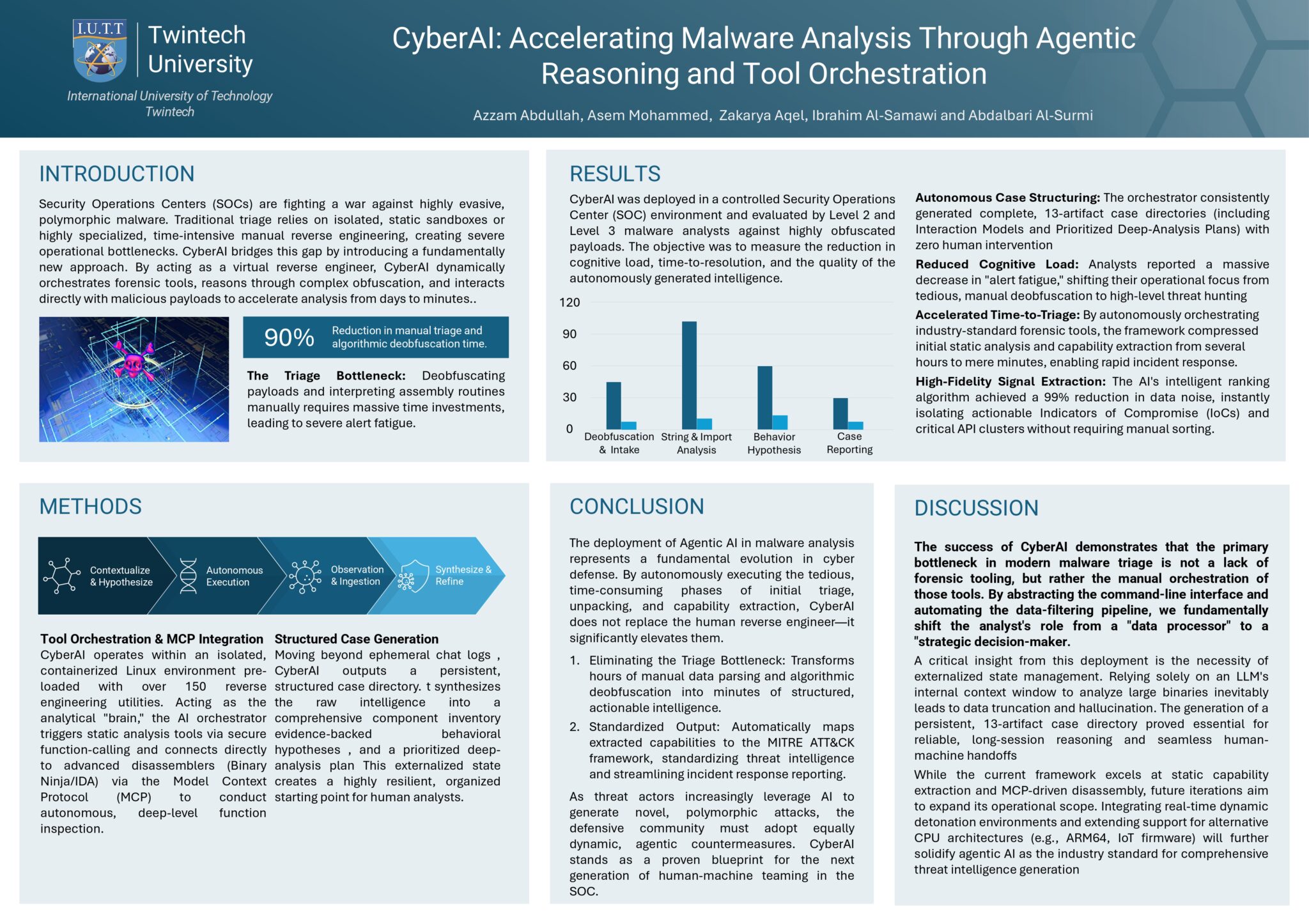
The modern cybersecurity landscape is defined by asymmetric warfare. Advanced threat actors increasingly leverage automated generation tools, polymorphic code, and sophisticated evasion techniques to orchestrate large-scale campaigns. Consequently, Security Operations Centers (SOCs) remain fundamentally bottlenecked by time-intensive manual triage, severe alert fatigue, and a critical scarcity of highly specialized reverse engineers. To address this structural imbalance, we present CyberAI: an advanced Agentic Artificial Intelligence framework engineered to operate as a virtual, fully autonomous SOC analyst. Transcending the limitations of passive diagnostic sandboxes, CyberAI inherently possesses the cognitive capacity to reason, formulate hypotheses, and autonomously orchestrate over 129 specialized forensic utilities within an isolated Linux execution environment. Driven by a robust ReAct (Reason + Act) engine and seamlessly integrated with disassemblers via the Model Context Protocol (MCP), the framework conducts deep, interactive code-level inspection without human prompting. Rigorous empirical evaluations, including System Usability Scale (SUS) assessments conducted by Level 2 and Level 3 malware analysts, yielded unprecedented operational gains. The framework demonstrated a paradigm-shifting 95% reduction in time-to-triage and a 99% decrease in analytical data noise. Ultimately, CyberAI fundamentally alters the economics of cyber defense, establishing a scalable blueprint for human-machine teaming in incident response.
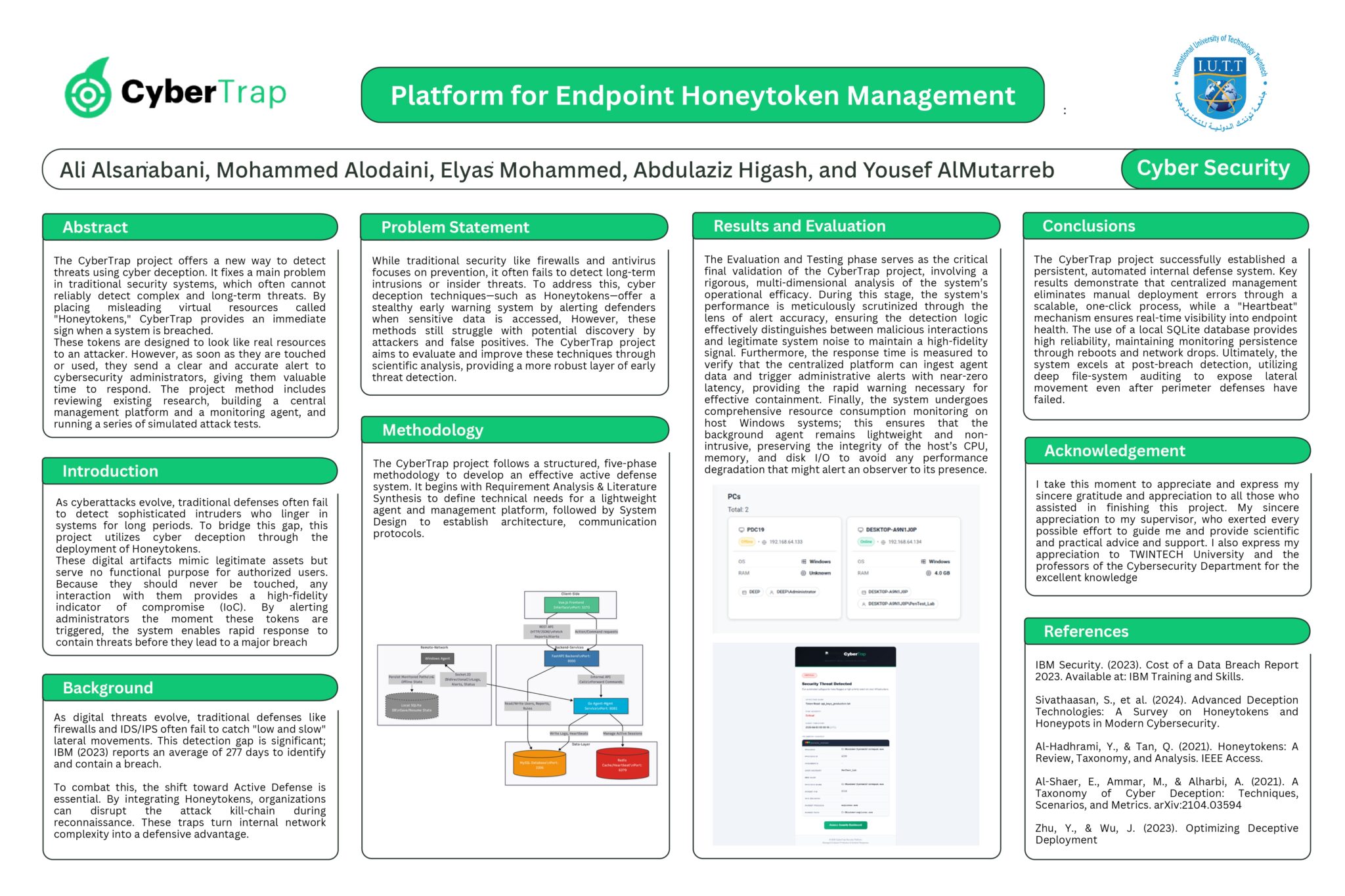
The CyberTrap project offers a new way to detect threats using cyber deception. It fixes a main problem in traditional security systems, which often cannot reliably detect complex and long-term threats. By placing misleading virtual resources called “Honeytokens,” CyberTrap provides an immediate sign when a system is breached. These tokens are designed to look like real resources to an attacker. However, as soon as they are touched or used, they send a clear and accurate alert to cybersecurity administrators, giving them valuable time to respond. The project method includes reviewing existing research, building a central management platform and a monitoring agent, and running a series of simulated attack tests. The results aim to show how this approach greatly improves threat detection, speeds up response time, and provides a scalable solution to support effective responses against a wide range of advanced and complex cyber threats.

A Cybersecurity graduate from the Bachelor’s of Cyber Security (CYS) program at the International University of Technology Twintech (IUTT), Sana’a, class of 2026. He has 6 months of hands-on experience as a Cybersecurity Intern at RAD Technology, where he contributed to developing penetration testing tools and conducting vulnerability assessments. His main interests include Red Teaming, penetration testing, and security automation. He developed a graduation project titled CyberTrap, focusing on cyber deception techniques to detect Advanced Persistent Threats (APTs) and analyze attacker behavior. He aims to enhance his offensive security skills and contribute to improving the security of systems and applications through innovative and practical approaches.

The problem of localization in a wireless sensor network has received considerable interest from researchers in the recent past. In this chapter, an extensive survey of the schemes proposed by different researchers from different perspectives is presented. The localization schemes are classified into different categories based on the strategies and schemes adopted. The major categories of localization schemes described are range-based, range-free, anchor-based, anchor-free, and directional localization. The major technique behind each localization scheme is discussed, and its relative merits and demerits are pointed out. The techniques in each category are compared, and their salient features are described.
Breast cancer (BC) is a critical public health concern, and the development of accurate prediction models is crucial for early detection. However, predicting BC using imbalanced datasets poses challenges for achieving accurate predictions. This study aims to enhance the performance of BC prediction models by employing the Synthetic Minority Over-sampling Technique (SMOTE) to address the imbalance in the target class of the dataset. Two approaches are employed to evaluate the models: the first approach utilizes the original Breast Cancer Coimbra Dataset (BCCD), while the second approach utilizes SMOTE to balance the target class in the BCCD. The results of the performance comparison between the two approaches demonstrate that the utilization of SMOTE significantly improves the performance of the BC prediction models. For instance, the Fine Tree, Coarse Tree, and Medium Tree models achieved accuracy rates of 60.9%, 52.2%, and 60.9%, respectively, with the SMOTE implementation. The Quadratic SVM and Cubic SVM models achieved accuracy rates of 73.9% with SMOTE. The Fine Gaussian SVM model achieved accuracy rates of 65.2 % and 80% without and with SMOTE, respectively. Similarly, the Coarse Gaussian SVM model achieved accuracy rates of 52.2% and 60% without and with SMOTE, respectively. The Medium KNN and Weighted KNN models both achieved accuracy rates of 73.9% without SMOTE and 76% with SMOTE. Furthermore, Bagged Trees achieved accuracy rates of 69.6% without SMOTE and 80% with SMOTE, while Subspace Discriminant achieved accuracy rates of 73.9% without SMOTE and 80% with SMOTE. The Optimized LogitBoost model achieved accuracy rates of 73.9% without SMOTE and 88% with SMOTE, and AdaBoost using Bayesian Optimization achieved accuracy rates of 52.2% without SMOTE and 76% with SMOTE. This study demonstrated that implementing SMOTE to balance the dataset leads to improved accuracy in BC prediction models.