

The main idea of this research is to create a highly reliable and robust machine learning system capable of accurately predicting student performance. This reliability is achieved using advanced validation techniques (nested validation) to prevent overfitting the model, as well as systematic rebalancing strategies to ensure the model performs fairly across all student categories, especially the minority at risk of failure.
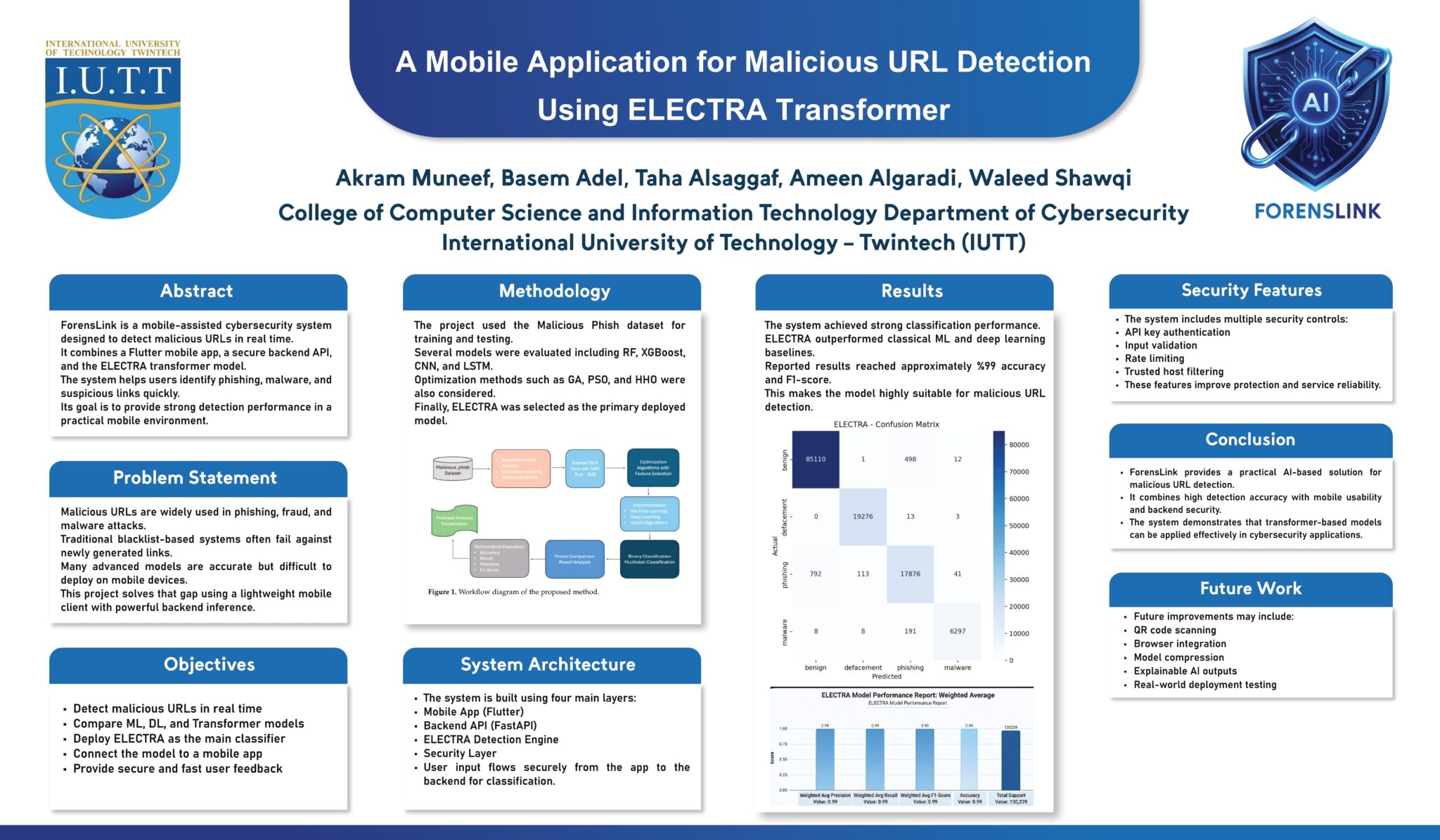
ForensLink is an innovative cybersecurity project designed to detect malicious URLs using advanced artificial intelligence techniques. The project addresses one of the most widespread digital threats: URLs used in phishing attacks, malware delivery, and online fraud. The system is built around the ELECTRA Transformer model to achieve highly accurate URL classification and is integrated into a mobile application supported by a secure backend service, enabling fast and practical real-time URL analysis. What distinguishes this project is its ability to bridge academic research and real-world implementation. Rather than stopping at model evaluation, ForensLink transforms advanced detection capabilities into a usable technical solution suitable for practical deployment. The project also emphasizes security through the design of a protected URL Classifier API featuring input validation, access control, rate limiting, and monitoring mechanisms. Overall, ForensLink reflects a modern cybersecurity approach that combines intelligence, efficiency, and usability to strengthen digital protection for both individuals and organizations.
An artificial intelligence system for analyzing and diagnosing medical fungi through images, aiming to improve the quality of medical diagnosis and accelerate the fungal detection process with higher accuracy than traditional methods.
Fungi AI: Artificial Intelligence project.
Republic of Yemen is a developing country. It depends on oil for the life needs. Regarding the availability of renewable energy resources, the country has huge solar resources. Due to crises and civil wars, most organizations turned to alternative energy sources, including solar energy. The research objective is to examine the impact of solar utilization and solar usage barriers on satisfying energy needs for the organizations. Self-administered structured questionnaire is utilized to conduct a survey of 250 private bank employees in Sana’a. A simple random sampling is used to distribute the questionnaires. A correlational study is applied using quantitative method and the path coefficients analysis is used to test proposed hypotheses. The main findings of the study are three-fold. Firstly, there is negative significance impact of usage barriers on the solar energy usage and satisfying organization’s needs. Secondly, the effect of usage barriers on the overall solar usage satisfaction is insignificant. Finally, solar energy usage has a positive significance effect on satisfying organizational needs and overall solar usage satisfaction.
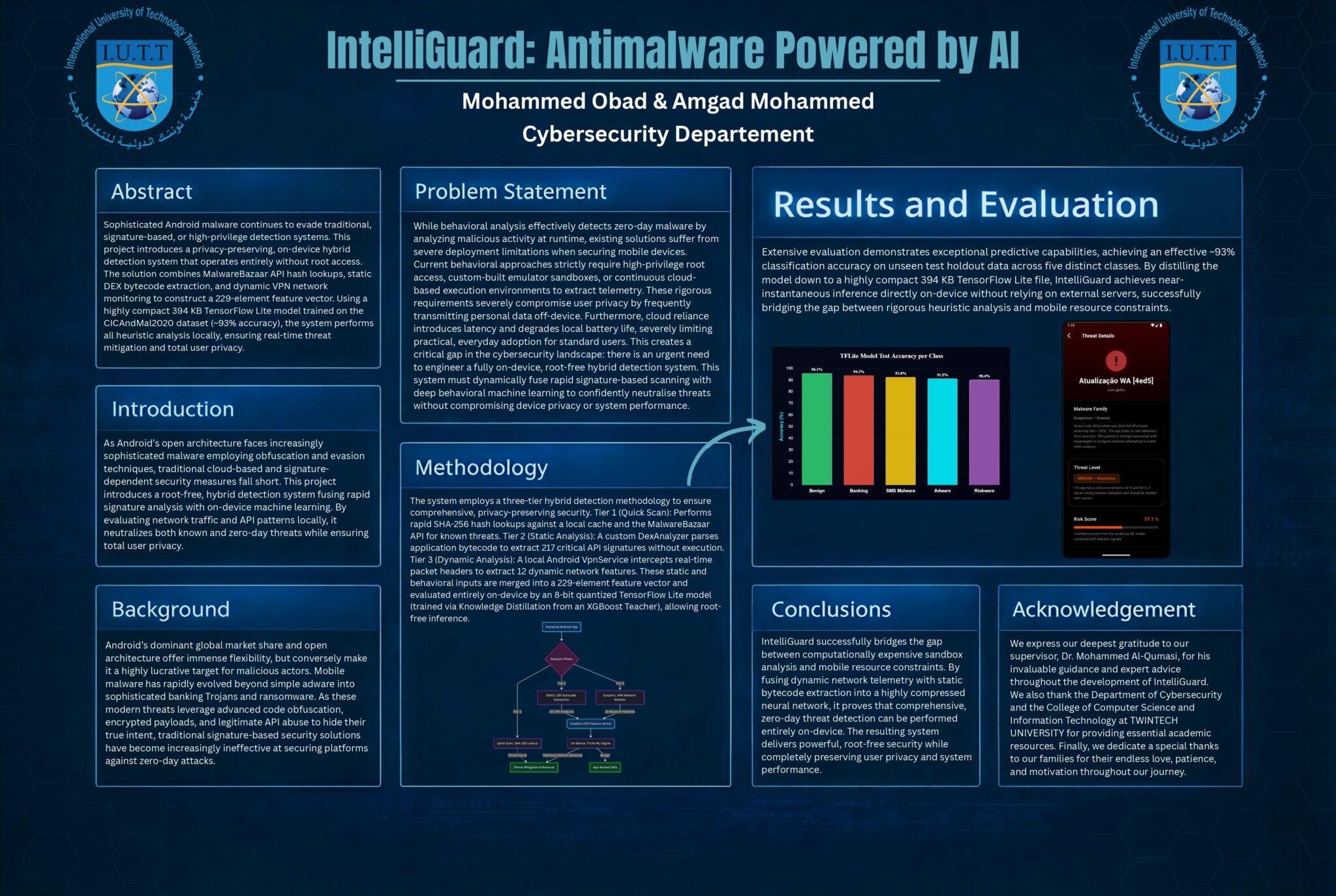
IntelliGuard, an Android application powered by a custom AI model designed for high-precision detection. The team initially trained a sophisticated model on over 11,000 real-world apps—both malicious and benign—achieving a 94% accuracy rate in distinguishing safe software from suspicious threats. The true technical achievement, however, lies in compressing this massive intelligence into a microscopic model of less than 400 KB that runs entirely on the device without internet access or data transmission to external servers, completing scans in under a tenth of a second. Unlike traditional antivirus tools that rely on static blacklists of known signatures, IntelliGuard identifies “Zero-Day” attacks by focusing on behavior rather than identity; it analyzes 229 different indicators to determine how an app acts, allowing it to catch brand-new threats unrecognized by any global database. Furthermore, the project overcomes a major academic hurdle by functioning on standard Android devices without requiring “Rooting,” meaning it provides seamless, background protection for the average user without compromising privacy or requiring dangerous system modifications.
Cybersecurity graduate from Tuntech University, interested in information security and network protection, and aiming to develop my skills and gain practical experience in this field.
Development of algorithms for discovering the location of nodes in a wireless sensor network is a task that offers a lot challenges to the research community. In this paper, we present a protocol for locating nodes in a wireless sensor network. The proposed protocol follows a locate-promote and split strategy. We analyze the number of iterations needed to locate almost all nodes in a network and the delays incurred in the process of localization. We show that the rate of localization of the proposed protocol in terms of the number of nodes localized with respect to the number of iterations is exponential.
It is an online platform called “MindConnect,” designed to provide online psychological counseling and therapy services in a professional and secure manner. The project aims to facilitate individuals’ access to psychological support in a confidential and comfortable environment, while adhering to academic standards and professional criteria in the delivery of these services.