
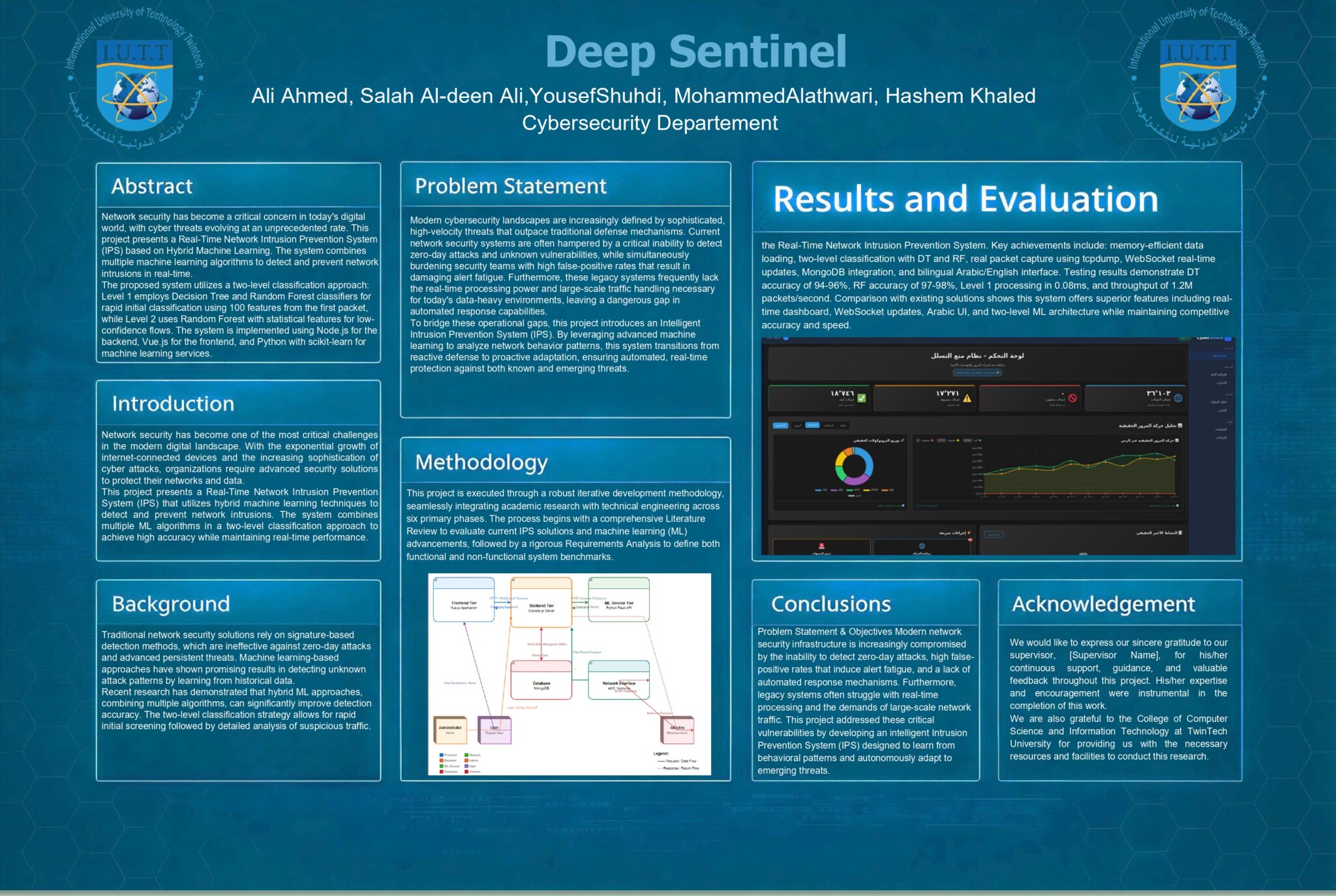
This project presents the design and implementation of a Real-Time Network Intrusion Prevention System (RT-NIPS) based on a machine learning methodology. The system addresses the fundamental challenge in network security: achieving both high detection accuracy and real-time processing speed simultaneously. The proposed system employs a two-level classifier architecture. Level 1 performs fast classification using Decision Tree (DT) on the first packet of each flow. Level 2 performs fine-grained analysis on low-confidence flows using Random Forest (RF) with full flow statistics. The system was trained and evaluated on two benchmark datasets: UNSW-NB15 and CICIDS2017. Key results demonstrate that the two-level approach successfully balances speed and accuracy.

Cybersecurity graduate from Tuntech University, Interested in the field of cloud computing security and GRC, and aiming to develop my skills and gain practical experience in this field.
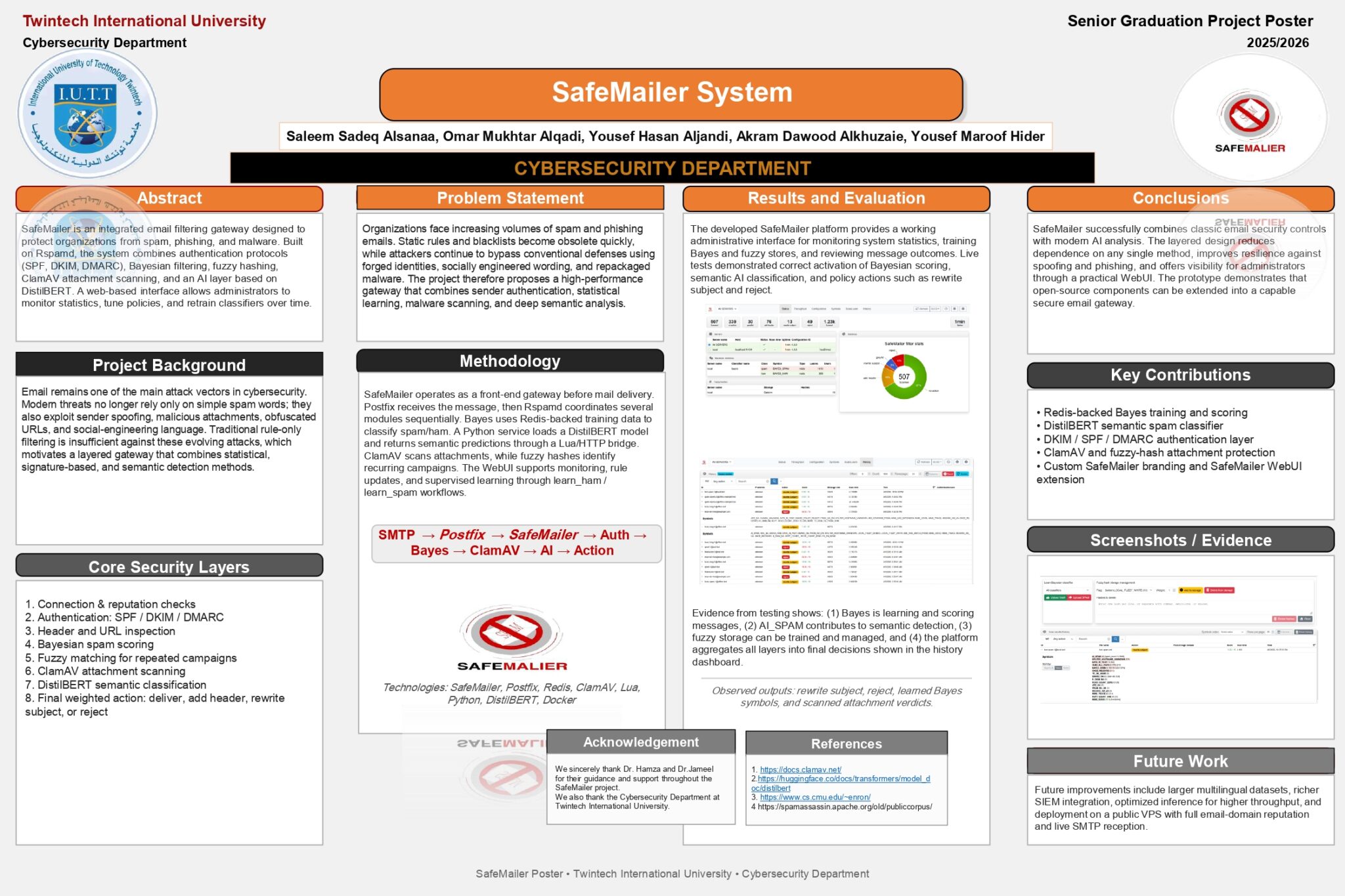
SafeMailer is an intelligent email filtering gateway designed to enhance organizational security against spam messages, phishing emails, and malicious software. The project is built on a multi-layered architecture that combines sender identity verification using SPF, DKIM, and DMARC protocols, statistical classification through the Bayes classifier, attachment scanning using ClamAV, and threat similarity detection through Fuzzy Hashing. In addition, the system employs the DistilBERT model as an artificial intelligence layer for semantic analysis of email content. The system also provides an administrative web interface for monitoring results, managing policies, and retraining classifiers, which contributes to improving detection efficiency, reducing false positives, and continuously enhancing overall system performance.
Computing, Internet, digital devices, smart devices, and other technologies were leading to a new terminology known as cloud of things (CoT). Cloud of Things is a powerful technology used to analyze and store massive data from thousands of distributed devices (smartphones, vehicles, home appliances, sensors, etc.). Further, Cloud of Things integrated two concepts, Internet of Things and Cloud Computing. There are many issues in cloud computing that have been widely studied, such as scheduling. On the other hand, a few issues have been studied in Cloud of Things. The objective of this paper is to discuss and classify the scheduling issues in Cloud of Things. Researchers have developed algorithms for different environments such as heterogeneous/homogeneous clusters, cloud computing, and large-scale community grids. By reviewing and considering many of these articles, we provided an overview for reuse these state-of-the-art algorithms in Cloud of Things environments. In addition, this paper provides researchers with ideas and platform for finding open research and exploring Cloud of Things issues.
The project offers a dual-platform (web and mobile) solution for traditional tailoring shops, aiming to transform their manual processes into a smart, comprehensive, and seamless digital experience. The system focuses on automating key operational aspects, including: Customer Relationship Management (CRM), dynamic tracking of each customer’s measurements, step-by-step order fulfillment management, automatic commission calculation for employees, and separate interfaces for management (web) and tailors (mobile). The system ensures financial transparency, high data security, and operational efficiency, enhancing shop productivity and customer satisfaction, and keeping pace with the digital transformation of businesses.

Smart system to automate traditional tailoring shop management.
The Contracting Office Management System (COMS) is a web-based platform designed to streamline and automate the daily operational workflow of construction and contracting offices. It addresses common industry challenges such as project delays, inefficient resource allocation, loss of critical documents, and financial mismanagement.The system offers integrated modules for project monitoring, employee and equipment management, digital document archiving, and comprehensive financial reporting.By providing centralized control and real-time operational insights, COMS enables contracting organizations to enhance efficiency, reduce administrative and technical errors, and support informed, data-driven decision making to improve overall business performance.
Designing a scheme for facilitating sensors in a WSN to compute their own locations is a challenging task. In this paper, we propose a scheme that equips sensors to estimate their own locations. In the proposed scheme, a sensor adds a set of virtual points for each location of a moving anchor. Using sets of virtual points together with actual locations of the moving anchor, it computes a convex hull. The points lying on the convex hull are used to construct an optimized circle whose center and radius is used to compute the location of the sensor iteratively. We have shown that the proposed scheme converges to the actual location of an unlocalized sensor. We observe that the localization error for the proposed scheme decreases with an increase in the number of iterations. The proposed scheme performs significantly better as compared to the existing schemes. Further, the proposed scheme provides a tradeoff between the accuracy of localization and the delay incurred during the process of localization.
Ambitious Cyber Security graduate seeking a practical internship in Cyber Security or SOC monitoring. Equipped with academic and practical foundations in network traffic analysis, vulnerability assessment, and malware analysis, with a keen interest in advancing skills in incident response.