
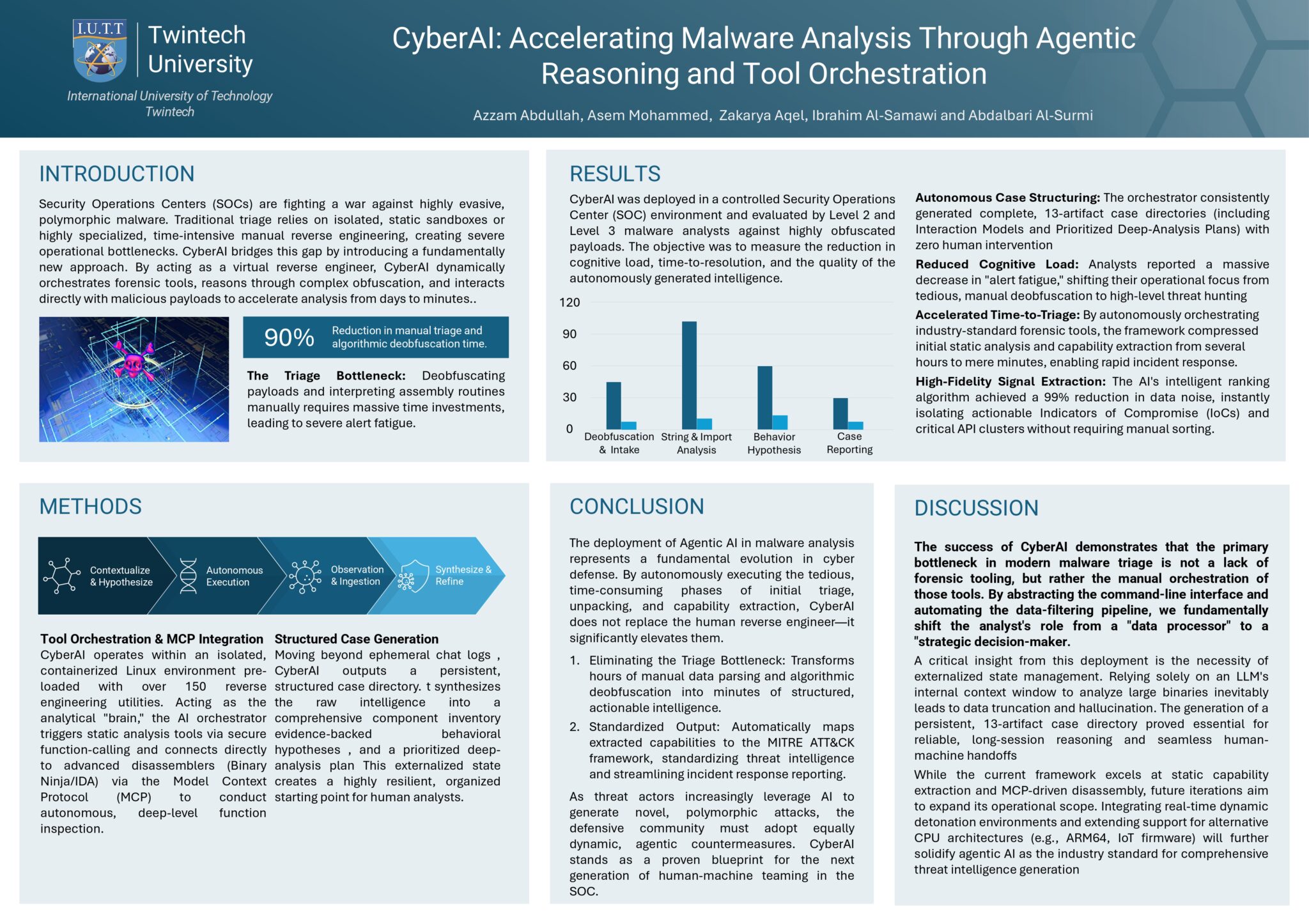
The modern cybersecurity landscape is defined by asymmetric warfare. Advanced threat actors increasingly leverage automated generation tools, polymorphic code, and sophisticated evasion techniques to orchestrate large-scale campaigns. Consequently, Security Operations Centers (SOCs) remain fundamentally bottlenecked by time-intensive manual triage, severe alert fatigue, and a critical scarcity of highly specialized reverse engineers. To address this structural imbalance, we present CyberAI: an advanced Agentic Artificial Intelligence framework engineered to operate as a virtual, fully autonomous SOC analyst. Transcending the limitations of passive diagnostic sandboxes, CyberAI inherently possesses the cognitive capacity to reason, formulate hypotheses, and autonomously orchestrate over 129 specialized forensic utilities within an isolated Linux execution environment. Driven by a robust ReAct (Reason + Act) engine and seamlessly integrated with disassemblers via the Model Context Protocol (MCP), the framework conducts deep, interactive code-level inspection without human prompting. Rigorous empirical evaluations, including System Usability Scale (SUS) assessments conducted by Level 2 and Level 3 malware analysts, yielded unprecedented operational gains. The framework demonstrated a paradigm-shifting 95% reduction in time-to-triage and a 99% decrease in analytical data noise. Ultimately, CyberAI fundamentally alters the economics of cyber defense, establishing a scalable blueprint for human-machine teaming in incident response.
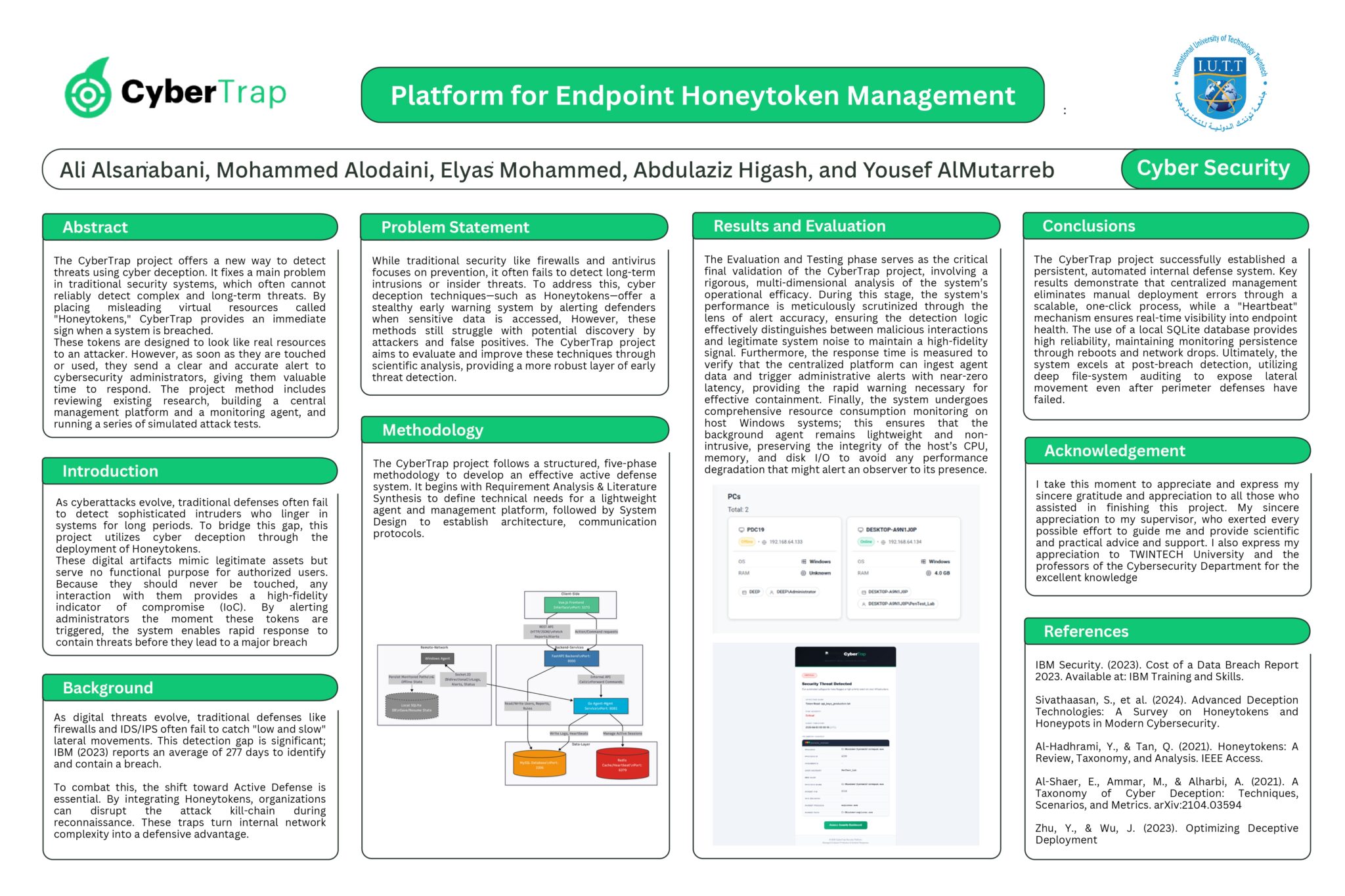
The CyberTrap project offers a new way to detect threats using cyber deception. It fixes a main problem in traditional security systems, which often cannot reliably detect complex and long-term threats. By placing misleading virtual resources called “Honeytokens,” CyberTrap provides an immediate sign when a system is breached. These tokens are designed to look like real resources to an attacker. However, as soon as they are touched or used, they send a clear and accurate alert to cybersecurity administrators, giving them valuable time to respond. The project method includes reviewing existing research, building a central management platform and a monitoring agent, and running a series of simulated attack tests. The results aim to show how this approach greatly improves threat detection, speeds up response time, and provides a scalable solution to support effective responses against a wide range of advanced and complex cyber threats.

A Cybersecurity graduate from the Bachelor’s of Cyber Security (CYS) program at the International University of Technology Twintech (IUTT), Sana’a, class of 2026. He has 6 months of hands-on experience as a Cybersecurity Intern at RAD Technology, where he contributed to developing penetration testing tools and conducting vulnerability assessments. His main interests include Red Teaming, penetration testing, and security automation. He developed a graduation project titled CyberTrap, focusing on cyber deception techniques to detect Advanced Persistent Threats (APTs) and analyze attacker behavior. He aims to enhance his offensive security skills and contribute to improving the security of systems and applications through innovative and practical approaches.
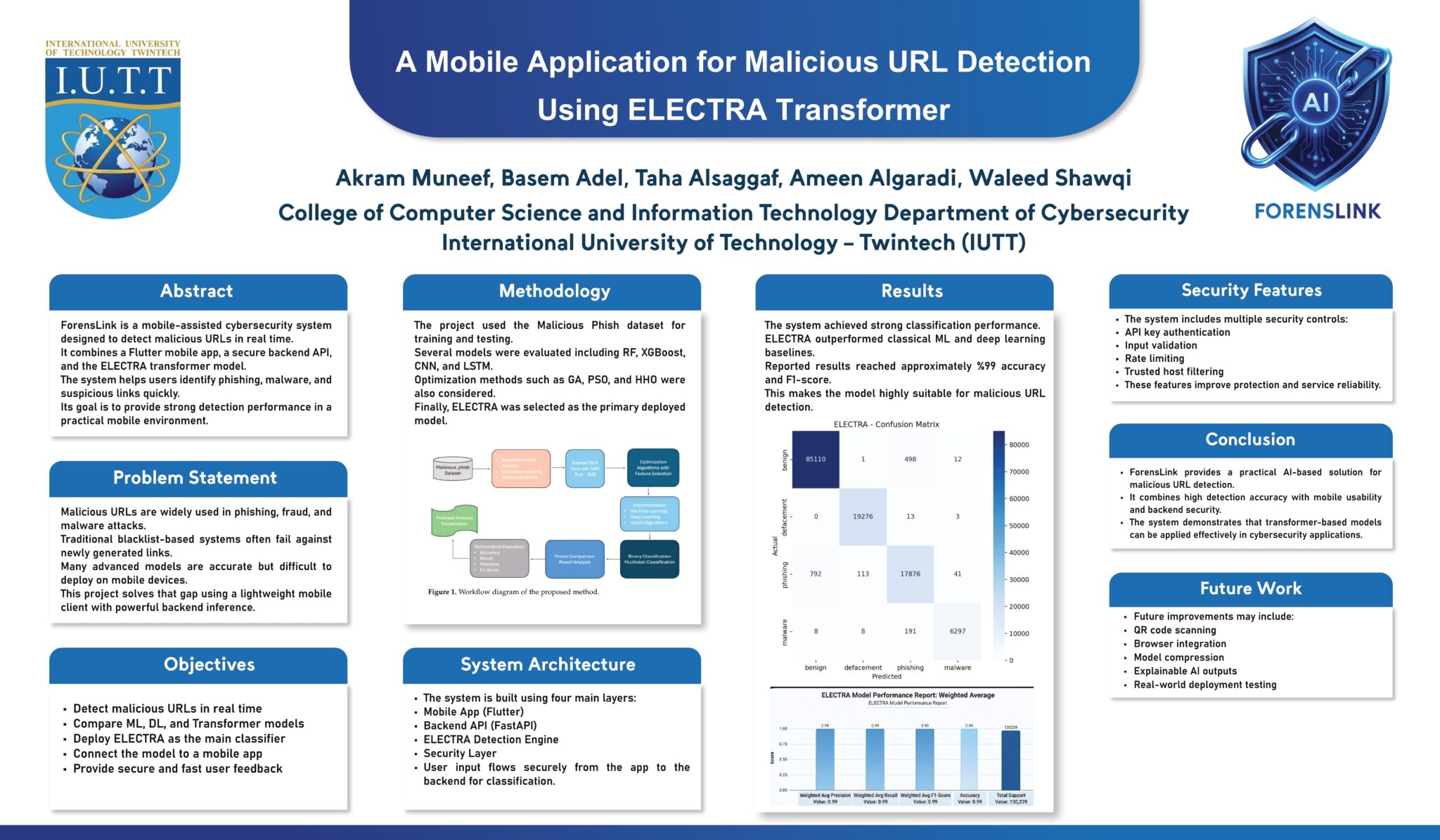
ForensLink is an innovative cybersecurity project designed to detect malicious URLs using advanced artificial intelligence techniques. The project addresses one of the most widespread digital threats: URLs used in phishing attacks, malware delivery, and online fraud. The system is built around the ELECTRA Transformer model to achieve highly accurate URL classification and is integrated into a mobile application supported by a secure backend service, enabling fast and practical real-time URL analysis. What distinguishes this project is its ability to bridge academic research and real-world implementation. Rather than stopping at model evaluation, ForensLink transforms advanced detection capabilities into a usable technical solution suitable for practical deployment. The project also emphasizes security through the design of a protected URL Classifier API featuring input validation, access control, rate limiting, and monitoring mechanisms. Overall, ForensLink reflects a modern cybersecurity approach that combines intelligence, efficiency, and usability to strengthen digital protection for both individuals and organizations.
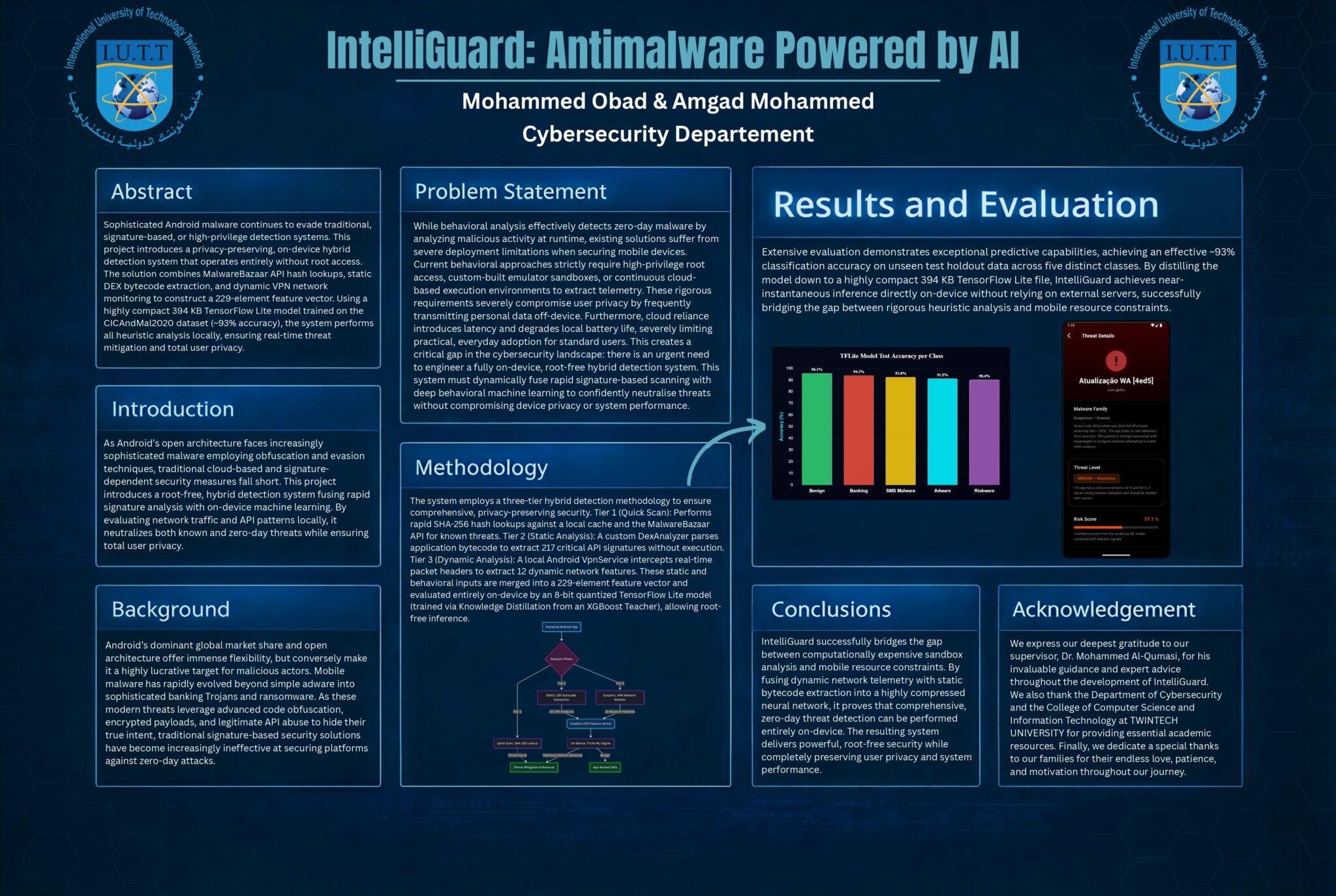
IntelliGuard, an Android application powered by a custom AI model designed for high-precision detection. The team initially trained a sophisticated model on over 11,000 real-world apps—both malicious and benign—achieving a 94% accuracy rate in distinguishing safe software from suspicious threats. The true technical achievement, however, lies in compressing this massive intelligence into a microscopic model of less than 400 KB that runs entirely on the device without internet access or data transmission to external servers, completing scans in under a tenth of a second. Unlike traditional antivirus tools that rely on static blacklists of known signatures, IntelliGuard identifies “Zero-Day” attacks by focusing on behavior rather than identity; it analyzes 229 different indicators to determine how an app acts, allowing it to catch brand-new threats unrecognized by any global database. Furthermore, the project overcomes a major academic hurdle by functioning on standard Android devices without requiring “Rooting,” meaning it provides seamless, background protection for the average user without compromising privacy or requiring dangerous system modifications.

Cybersecurity graduate from Tuntech University, interested in information security and network protection, and aiming to develop my skills and gain practical experience in this field.
A Cybersecurity graduate from the International University of Technology Twintech (IUTT), class of 2026. He currently works as a SOC Analyst at DeepSafer, serving as a Tier 1 Team Leader, where he is involved in security monitoring, threat analysis, and incident response. His main interests include defensive security, log analysis, threat hunting, malware analysis, and digital forensics. He has gained practical experience in handling security incidents and analyzing threat behavior in real-world environments. He aims to further develop his skills in blue team operations and enhance his capabilities in threat detection and incident response, contributing to strengthening organizational security.
A Cybersecurity student with a strong interest in network security and threat detection. Currently working on a graduation project focused on developing a Real-Time Network Intrusion Prevention System using machine learning techniques to enhance network protection and respond to threats instantly.